Quick answer
For a U.S. passport photo, hair is usually not the problem by itself. The problem starts when hair makes the face harder to review.
The safest public interpretation of the Department of State guidance is simple:
- keep a clear full-face view;
- keep both eyes open and easy to see;
- avoid hair that covers important facial features;
- avoid hair that casts shadows across the face.
That means you do not need a special haircut, a strict updo, or a “passport photo hairstyle.” But if bangs, curls, loose hair, or side volume cover the eyes, cheeks, jawline, or edge of the face, the safer move is to retake the photo.
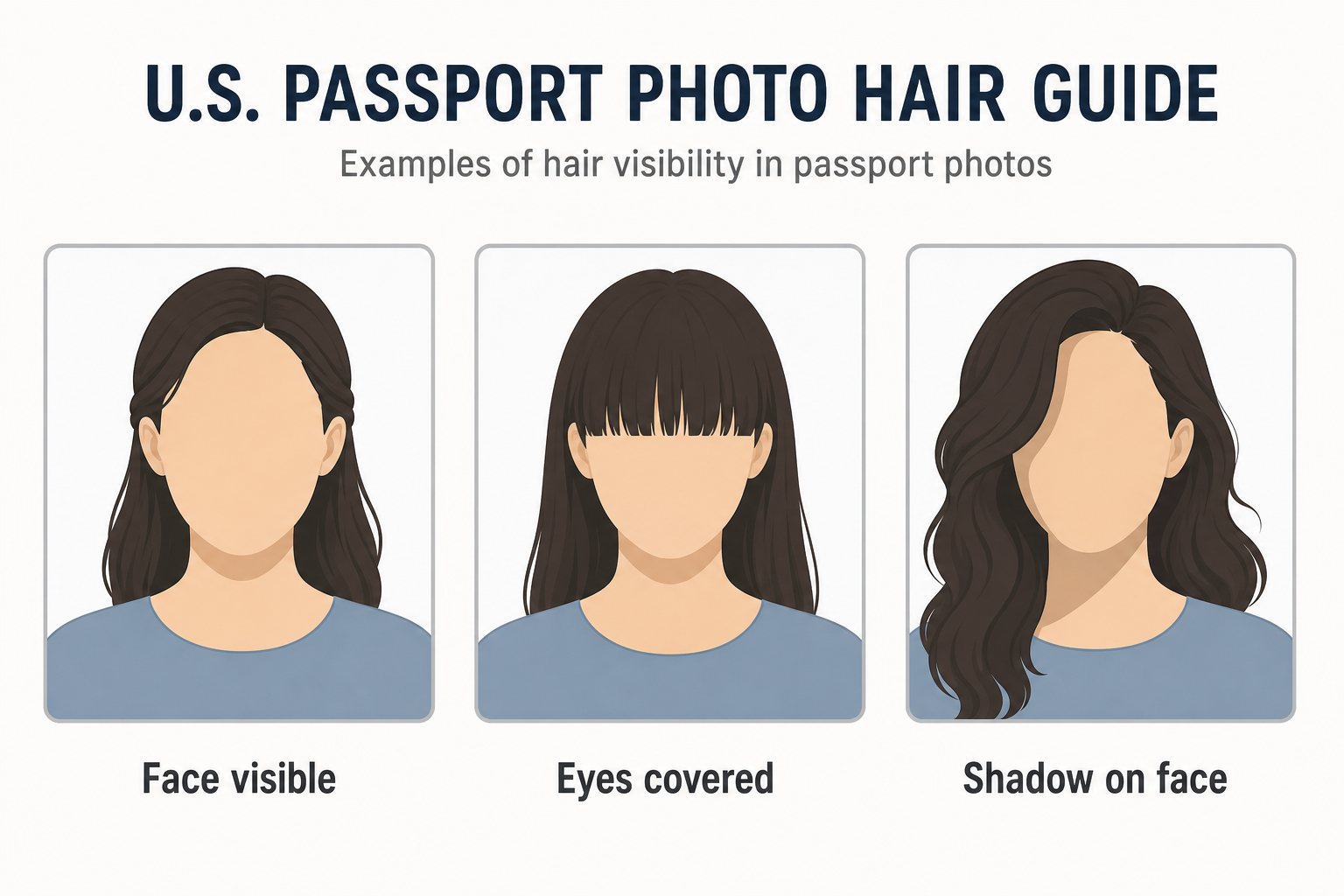
Requirement table
| Question |
Safe U.S. passport-photo interpretation |
Common mistake |
| Bangs |
Fine only if both eyes and eyebrows stay easy to see |
Bangs drop low enough to cover the eyes or create a shadow |
| Hair down |
Usually fine if the full face remains visible |
Hair spreads across the cheeks, jawline, or face outline |
| Hair behind ears |
Optional, not a rule by itself |
Leaving hair forward when it hides the side of the face |
| Hairline |
No special haircut is required, but the face must still read clearly |
Treating the hairline as irrelevant when hair or a covering obscures the face |
| Volume and curls |
Fine only if lighting stays even and the face stays clear |
Thick side volume or curls cast a shadow across one side of the face |
| Private precheck |
Useful for visual prep only |
Assuming a private tool decides official acceptance |
What the Department of State rule means in practice
The Department of State passport and visa photo pages do not publish a long hairstyle dress code. Instead, they publish broader photo rules: a clear image of your face, full-face view, both eyes open, and no shadows or obstruction that make identity review harder.
That is why hair questions should be handled as face-visibility questions, not as beauty or fashion questions. Hair is acceptable when it leaves the face easy to compare. Hair becomes risky when it changes the clarity of the identity image.
In practical terms, hair is unsafe when it:
- covers one or both eyes;
- hides the eyebrows so much that the eye area becomes unclear;
- falls across the cheeks, jawline, or chin;
- hides the edge of the face outline;
- creates a strong shadow over the forehead, eyes, cheeks, or jawline.
Bangs: acceptable only when the eyes stay clear
Bangs are one of the most common passport-photo worries. The safest standard is not “no bangs.” The safer standard is no visual obstruction.
If your bangs stay light, separated, and high enough that both eyes remain easy to see, the photo can still fit the public rule set. If they drop over the eyes, darken the brow line, or make one eye look less visible than the other, retake the photo with the hair moved back.
Do not rely on retouching to “fix” bangs after the fact. For U.S. document photos, it is safer to take a new real photo than to alter the appearance digitally.
Can you wear your hair down?
Usually yes. Hair down is not automatically a passport-photo problem.
The main risk is what hair down does to the edges of the face. Long hair, curls, or thick side sections can hide the jawline, cheeks, or part of the chin if they sit too far forward. The safest setup keeps the face outline readable from chin to upper head while still allowing a natural hairstyle.
If you are not sure whether hair down is too wide or too forward, compare the photo at thumbnail size. If the face shape is less clear because the hair is taking over the frame, retake it with the hair moved slightly back.
Does hair have to be behind your ears or does the hairline have to show?
Not necessarily. There is no broad public rule saying every ear must show or that you need a special haircut just for a passport photo.
The safer interpretation is narrower: the face must stay easy to review. If leaving your hair forward makes the cheeks, jawline, or side outline less clear, move it back. If the hairstyle keeps the face clear, a natural style can still work.
The visa photo page also warns against a hat or head covering that obscures the hair or hairline unless it is worn daily for a religious purpose. That does not create a hairstyle rule by itself, but it reinforces the broader idea that the upper edge of the face and head should remain visually readable.
Shadows, volume, and side lighting
Hair can create a rejection risk even when it does not literally cover the face. Heavy side volume, curls, or a swept-forward style can cast a shadow over the forehead, temple, eye area, or cheek.
The passport photo page explicitly warns that overhead or side lighting can cast shadows on the face and obscure facial features. That matters for hair too. If thick hair plus side lighting darkens one side of the face, treat it as a photo setup problem and retake the image with more even front lighting.
Hair questions are different from head-covering exceptions
If your concern is really about a hijab, turban, scarf, wrap, or medical covering, that is not just a hairstyle question. It belongs in the separate Department of State exception path.
For that case, use US passport photo head covering requirements. This hair guide stays focused on natural hairstyle choices like bangs, loose hair, curls, and face visibility.
What YapaPhoto can help with
YapaPhoto's U.S. passport-photo path starts from a real uploaded photo. It can help prepare a U.S. passport-style digital crop/export and surface obvious visual issues such as face obstruction, shadows, wrong crop, busy background, or edits that make the photo unsafe.
Keep the product boundary clear: YapaPhoto is a private preparation tool. It is not the Department of State, is not affiliated with the U.S. government, and does not replace final agency review. The current U.S. path is a digital crop/export workflow; checkout and print-board delivery are not enabled for this standard yet.
Start with the U.S. passport photo preparation path. For the full checklist, read US passport photo requirements. If the issue is a scarf, hat, or religious or medical covering, use US passport photo head covering requirements.
Step-by-step workflow
- Face the camera directly. Start with a straight full-face view and both eyes clearly visible.
- Check the eye area first. If bangs or loose strands cross the eyes or darken the brow area, move the hair and retake the photo.
- Check the side outline. Make sure hair does not hide the cheeks, jawline, chin edge, or overall face outline.
- Fix the lighting, not the file. If curls or side volume create a shadow, retake the photo with more even front lighting instead of editing the image.
- Separate hairstyle from exception cases. If the issue is really headwear or an exception path, switch to the exact official guidance for that case.
- Use a real current photo. Avoid AI generation, appearance-changing retouching, or software edits that alter hair, face shape, or shadows.
Source-backed checklist before submitting
Before you upload or print a U.S. passport-style photo, confirm that:
- both eyes are open and easy to see;
- hair does not cover the eyes, eyebrows, cheeks, chin, or jawline;
- the side outline of the face is still readable;
- no hair shadow falls across the forehead, eyes, cheeks, or jawline;
- the photo is recent, in color, and not filtered, retouched, or AI-generated;
- the final document path you are using does not add stricter instructions.
FAQ
Can I have bangs in a U.S. passport photo?
Yes, if the bangs do not cover the eyes or make key facial features harder to see. If they sit too low or cast shadows, retake the photo.
Can I wear my hair down in a passport photo?
Usually yes. Hair down is acceptable when the full face remains clearly visible and the lighting stays even.
Does my hair need to be behind my ears?
Not necessarily. The safer rule is face visibility, not a mandatory hairstyle. If moving the hair behind the ears is what makes the face outline clear, do that before retaking the photo.
Does my hairline have to show?
There is no broad public rule requiring a special haircut, but the face and upper head still need to read clearly in the photo. If hair or any covering obscures that clarity, retake the photo.
Who makes the final decision?
The government agency or official submission process makes the final decision. YapaPhoto can help prepare and precheck a real-photo crop/export, but it cannot act as an official reviewer.